Feeds:
Posts
Comments

48. Weathered wood

In our culture, new is usually considered better. And where so-called home improvements are concerned, that is often the case, especially if the new item is a high-efficiency furnace or a forty-year roof or an energy-saving kitchen appliance. But sometimes the situation is more complex than that, the effect more problematic.

Recently we installed new vinyl windows in our home. In contrast to the fifty-year-old relics they replaced, the new windows bring a soft, expansive light into our darker rooms. Gone are the small panes and splintered mullions. Gone, too, are the uncaulked cracks and loose-fitting frames that let out heat. Our house feels tighter now, and our carbon footprint will almost certainly be smaller.

Yet with this welcome change has come an unexpected loss. Clean and efficient though they are, our new windows lack a quality that was palpably present in the decrepit pine windows they replaced. In American parlance that quality is sometimes called “character,” and it is said to reside in such objects as weathered deck chairs, antique tools, and Willie Nelson’s battered guitar. Our rattling old windows, such as they were, had character; our new vinyl windows, whatever their environmental virtues, do not.

In Japanese culture, the quality I’m describing is known as sabi, and it has an integral connection to the practice of Zen. Often linked with wabi, which connotes simplicity and a life free of materialistic striving, sabi once meant “loneliness” or “solitude”.  In modern usage, it means the quality of being old, worn, and faded—and all the more beautiful for the wear and tear. The architect Tadao Ando defines the quality in this way:

Sabi by itself means “the bloom of time.” It connotes natural progression—tarnish, hoariness, rust—the extinguished gloss of that which once sparkled. It’s the understanding that beauty is fleeting. .  . Sabi things carry the burden of their years with dignity and grace: the chilly mottled surface of an oxidized silver bowl, the yielding gray of weathered wood, the elegant withering of a bereft autumn bough.*

Noting that sabi “transcends the Japanese,” Ando finds it in “an old car left in a field to rust, as it transforms from an eyesore into a part of the landscape.” This, he suggests, might be considered “America’s contribution to the evolution of sabi.”

Beyond the aspect of age, the word sabi also connotes imperfection. Rooted historically in the tea ceremony, the aesthetic of sabi developed in the sixteenth century as an indigenous reaction to the expensive teaware imported from China. In contrast to the brilliant colors and ostentatious perfection of Chinese wares and utensils, the tea masters Murata Shuko, Takeno Jo-o, and especially Sen no Rikyu (1522-1591) introduced such rough, imperfect objects as stoneware buckets and tea bowls produced by local craftsmen. In subsequent centuries, the aesthetic thus established extended to a general appreciation of imperfect objects, whether the object be a bamboo screen or a leaky vase. As the feudal baron Lord Fumai (1751-1819), himself the owner of a leaky vase, explained, “The furyu [sabi] of this  bamboo vase consists in the very fact of this leakage.”**

Yet if the objects that embody sabi are imperfect, it is not because they were poorly made. Nor is their imperfection a sign of neglect. On the contrary, as Tadao Ando remarks, “wabi-sabi is never messy or slovenly,” and an unmade bed or a room cluttered with junk is not an expression of sabi. Objects that possess sabi do so because they are visibly in the process of breaking down and reverting to the state of nature. Their imperfection is a mark of their impermanence. To contemplate sabi is to be reminded of the emptiness from which all things come and to which they will return. It is also to be reminded of the dynamic web of life, in which energies are constantly being exchanged, and new forms are coming into being.

The aesthetic of sabi and the practice of Zen are branches of a single cultural tree, and they have much in common. In both, a heightened awareness of impermanence draws us closer to the evanescent beauty of the present moment.  In both, the pathos of things going in and out of existence mingles with a sense of infinite possibility. And in both, the realization that all things are transitory prompts us to value and care for our lives.

_______________

*Tadao Ando, “What is Wabi-Sabi?”   http://nobleharbor.com/tea/chado/WhatIsWabi-Sabi.htm

**Daisetz T. Suzuki, Zen and Japanese Culture ( Princeton 1970), p. 326.

See also Leonard Koren, Wabi-Sabi for Artists, Designers, Poets, & Philosophers (Berkeley: Stone Bridge Press, 1994).

2009_1114ABHVISIT20070004

Patience, we are told, is a virtue. As a child growing up in eastern Iowa, I heard that bromide more than once. However, as an adolescent I learned about patience not from listening to Methodist sermons or elders’ proverbs but by spending time with an exceptionally patient man.

His name was Sven Jorgensen, and he was the co-owner of Eble and Jorgensen Office Supply, where I worked after school, on weekends, and in the summers. Unlike Fred Eble, a former Navy Seabee and a tense, frenetic striver, Sven exuded steadiness and calm. Wiry, high-strung Fred dealt with the public and could often be found in the front of the store, filling out orders or talking on the phone. Thick-set, sedentary Sven worked quietly at his table in the back room, cleaning and repairing typewriters. Nearby was a photo of Sven and his dog Walt in a flat-bottomed fishing boat. Like his owner, Walt looked stable and relaxed.

To everyone in town, Sven Jorgensen was known as Speed. Speed Jorgensen. He acquired that name at the age of fourteen, when he barreled down a steep hill on his bike, rode into a pile of frozen leaves, and flew over the handlebars. He hadn’t realized that the leaves were frozen. Ever after, all physical evidence to the contrary, Sven would be known as Speed. It was a lifelong joke, played by the world on a slow-moving Swede.

At Eble and Jorgensen’s I sometimes waited on customers, made deliveries, or stocked shelves, but much of the time I worked in the back room, where dirty or broken typewriters waited to be restored. With his big Swedish hands Speed would carry them, one by one, to his table, where he put them in a deep tray half-filled with solvent. There he would clean their typebars with a solvent-soaked toothbrush, adjust their springs, replace broken or tarnished keys. When he was finished, even the most abused machine would function smoothly and look as good as new.

Much of the time, Speed worked silently, as did I, but sometimes we chatted as we worked. Or rather, I talked and Speed listened, offering advice when advice was sorely needed. Once, when I had manged to deliver rubber cement rather than duplicating fluid to an office, nearly precipitating a crisis, Speed sharply admonished me to be more attentive. On another occasion, when I was enumerating my father’s faults, Speed remarked, without looking up, that my father was a very nice man. And once, when I repeated a mean-spirited joke I’d heard at school, he told me in so many words that my joke was not very funny. I would not repeat it again.

In his unchosen role as friend and mentor, Speed taught partly by precept but mostly by example. What he exemplified was not only patience but also the virtue of slowing down, even when typewriters needed to be cleaned or supplies delivered. Working slowly but productively at his table, or pausing in his work to offer kind advice, he provided vivid proof that life could be lived at a slower pace, allowing time to look more deeply and act more wisely.

The pace at which Sven Jorgensen lived and worked is also the pace of meditation. “Do you have the patience to wait,” asks Lao-Tzu in the Tao Te Ching, “till your mud settles and the water is clear? / Can you remain unmoving / till the right action arises by itself?” And in his book Meditation as Contemplative Inquiry, the physicist Arthur Zajonc observes that “hurrying is antithetical to the required tempo of meditation”. Elaborating that point, he notes that “the tempo of meditation is the same as that of artistic attention; it is the rhythm of poetry. Speed hides all subtlety; and reality is subtle.” *

Which of us isn’t in a hurry? Although my son once referred to me as his slow-moving dad, I too can get in a rush, lose all patience, and miss the subtleties of experience. If I need a retardant, I can find it in the image of Lao-Tzu, writing immortal poetry in his mountain retreat. Or, closer to home, I can call back the memory of Speed Jorgensen at his table, patiently scrubbing an ink-filled “o,” or winding a cloth ribbon on a spool, or calmly wiping a well-worn platen.

___________

* Arthur Zajonc, Meditation as Contemplative Inquiry (Lindisfarne, 2009), p. 98.

46. Chazen ichimi

2009_1031ABHVISIT20070017

Hohryu Kyusu

For at least eight centuries the practice of Zen has been closely linked to the consumption of green tea. In 1191 the Zen monk Eisai returned to Kyoto from his studies in China, bringing a bag of tea seeds, which he planted in the temple garden.  In 1211 he wrote Kissa Yojoki (The Book of Tea), Japan’s first tea book, extolling the healthfulness of green tea. Ever since, Zen practitioners have used green tea to nurture their bodies, soothe their minds, and keep themselves awake during their long hours of sitting. “Chazen ichimi,” declared the sixteenth-century tea master Sen Sotan:  “Zen and the taste of tea are one and the same”.*

Over the past two decades, health-conscious Americans have also brought green tea into their daily lives, but where taste is concerned, the reviews have been decidedly mixed.  “Would you drink green tea,” a skeptical friend once asked, “if you didn’t know it was good for you?” And another, whose taste in beverages runs to single-malt Scotch and a good Merlot, reported that he tried green tea and it tasted like pasteboard. If that is the taste of Zen, so much the worse for Zen.

If you too have tried green tea and found it not to your liking, that may be the end of the matter. However, if you already drink green tea but would like to enjoy it more, you can do so by making a small investment in equipment and by following a few time-honored instructions. With patience, care, and a little practice, you might find yourself enjoying a delicious, authentic cup of Japanese green tea.

First of all, you will need fresh tea. What is available in the supermarket or even in specialty tea shops is often anything but fresh. It may have been languishing in a tea bag or bin for a very long time. I order tea directly from Hibiki-an (www.hibiki-an.com), a  family-owned firm in Kyoto, and it arrives in a few days, sealed in a foil-lined bag. When I open the bag, the aroma of the unbrewed tea is itself enticing.

Second, you will need a kyusu, an earthenware teapot designed expressly for brewing green tea. For the price of a coffeemaker you can buy a kyusu online, and it’s well worth the expense. The distinguishing features of the kyusu include its hollow side handle and its interior mesh filter, which covers the opening of the spout. In contrast to the familiar infuser, the latter feature allows the tea leaves to open and to float freely in the water, releasing their flavor.

Third, you will need the softest, purest water you can find. Hibiki-an recommends Evian, Rocky Mountain, and other bottled waters. Here in Western New York, I use Chemung Spring Water, and it has proved equal to the task.

Fourth, you will need to pay attention to the temperature and the brewing time. On most mornings I drink a refreshing Sencha tea, which is brewed at 176 degrees Fahrenheit for sixty to eighty seconds. Other teas require other temperatures and brewing times. At first, you will need to use a thermometer and to watch the time very carefully. Later on, you can dispense with the thermometer, and you can adjust the prescribed time to suit your taste.

To brew two cups of Sencha tea, boil the water, let it cool for a minute, and pour it into the kyusu.  When the water has cooled for another minute, pour it into two of the three cups. Drain any remaining water from the kyusu.

Next, pour the water back and forth among the three cups. This process heats the cups and further cools the water. It also allows the water to oxygenate, which improves the flavor of the tea. Check the temperature. When it is around 176 degrees, add a tablespoon of loose Sencha tea to the heated kyusu and pour in just enough water to cover the leaves. Replace the lid, and wait for twenty seconds, letting the leaves absorb the water. Then add the rest of the water, and brew for a minute or slightly longer.

Now pour the tea alternately into two of the cups, and offer one to your guest. Lifting your own cup with both hands, take time to inhale the aroma of the tea. Contemplate its provenance, its impermanence, and its beneficial influence on your mind and body. Then drink it slowly, with full attention, and enjoy the taste of Zen.

_____________________________________

*For further information, see Barry Briggs’ weblog  Go Drink Tea at http://www.godrinktea.com/. See also D.T. Suzuki, Zen and Japanese Culture (Princeton, 1993), pp. 269-314; Soshitsu Sen, Tea Life, Tea Mind (Weatherhill, 1979); and Kakuzo Okakura, The Book of Tea (Stone Bridge Press, 2007).

45. Closing doors

DoorwaysThere are many ways to close a door. It can be done angrily or in haste. It can be done with infinite care. When Thich Nhat Hanh, then a young Vietnamese monk, visited the Trappist monk Thomas Merton at the Abbey of Gethsemani in Kentucky in 1966, Merton observed how his guest opened and closed the door. From that action alone, Merton later remarked, he could tell that Thich Nhat Hanh was “an authentic monk”.

Presumably, Thich Nhat Hanh closed the door quietly and with full attention, as his monastic training had taught him to do. In his book Zen Keys, he explains the purpose of that training:

The master can see if the student is or is not “awake.” If, for example, a student shuts the door noisily or carelessly, he is demonstrating a lack of mindfulness. Closing the door gently is not in itself a virtuous act, but awareness of the fact that you are closing the door is an expression of real practice. In this case, the master simply reminds the student to close the door gently, to be mindful. The master does this not only to respect the quiet of the monastery, but to point out to the student that he was not practicing mindfulness, that his actions were not majestic or subtle.*

Although he is articulating a general principle, Thich Nhat Hanh is also recalling a personal experience. As a sixteen-year-old novice, he closed a door with less than full attention, and his teacher called him back for a second try. That experience was, in his words, his “first lesson in the practice of mindfulness”.

In Zen practice the closing of a door is only one of some ninety thousand “subtle gestures,” each an expression of mindfulness. Symbolically, however, the opening or closing of a door has special importance, insofar as it signifies a moment of transition.  In his poem “Men at Forty” the American poet Donald Justice employs that traditional symbol, as he observes that “Men at forty / Learn to close softly / The doors to rooms / They will not be coming back to”. As they stand “At rest on a stair landing,” these newly middle-aged men “feel it moving / Beneath them now like the deck of a ship, / Though the swell is gentle.”**

In her book Making Friends with Death, Judith Lief employs the same symbol to describe the transitions in our lives:

Transitions are like doorways. When we open a door, we think we know what we will find on the other side, but we can never be sure. We do not know with certainty whether we will find a friend or an enemy, an obstacle or an opportunity. Without actually opening the door and walking through, we have no way of knowing. When we face such a door, we feel uncertain, vulnerable, exposed. Our usual strategies do not hold. We are in no-man’s-land. Transitions make us uncomfortable, and they are often accompanied by some degree of pain, but at the same time, they open us to new possibilities.***

Acknowledging that each moment of experience is a transition, “bounded by its own birth and death,” Lief reminds us that transitions often engender fear. Like Justice’s forty-year-olds on their moving decks, we feel uncertain and insecure. As a counter-measure, Lief urges us to pay close attention to all the transitions in our lives, however small, and to abide, if we can, in uncertainty, rather than retreat to what we know.  By so doing, we “begin to loosen our habitual fear of the unknown and undefined”.

For many of us, that noble goal is not so easily attained. It is one thing to learn, as Thich Nhat Hanh did, how to close a door with full attention. It is another to learn how to witness and accept transitions, whether they  be from youth to middle age, working life to retirement,  robust health to chronic illness, a stable marriage to sudden widowhood. But, in truth, the two kinds of learning are of a piece, and the one is training for the other. By learning to be mindful of the “ninety thousand subtle gestures,” we cultivate an ability to cope with the not-so-subtle changes that befall us. By learning to close an actual door with full awareness, we strengthen our capacity to pass, with grace and affirmation, through the wider doorways that lie ahead.

_________________

*Thich Nhat Hanh, Zen Keys (Thorsons 1995), 29

**Donald Justice, New and Selected Poems (Knopf 1995), 76

***Judith L. Lief, Making Friends with Death (Shambhala 2001), 15

44. A mighty wave

2009_1003ABHVISIT20070007One afternoon in August I waded into the ocean at Dewey Beach, Delaware. Under the hot sun, the waist-high breakers crashed against me. To steady myself, I adopted a T’ai Chi stance, keeping my center of gravity low. Wading just behind me was my wife, Robin, who is sometimes quite excitable.

“Oh, my God!” Robin exclaimed.

Thinking that she had seen something unusual on the beach—a three-legged dog, perhaps—I  looked over my shoulder. The next thing I knew, I was lying flat on my back in the water, looking up at the blue sky. A mighty wave had struck me down.

However startling, my experience was not uncommon. Nor is it unusual, in these times, for people who thought they were on a steady footing to be knocked flat by an unexpected force, whether the mighty wave take the form of a lost job, a foreclosed home, or a frightening diagnosis. When such things happen, of what use is the practice of Zen?

If you have tried meditation and found it foreign or difficult or boring, your answer might well be “very little”. But as a longtime practitioner, I would suggest three ways in which Zen and other forms of meditation can help us cope with adversity.

First and most obvious, meditation steadies the mind. That is particularly true of the concentrative forms of meditation, which include concentration on the breath, an image, or a mantra. Even a few minutes of concentrative meditation can leave the practitioner feeling calmer, steadier, and more in control. The effect may be temporary, but over time this form of meditation, diligently practiced, engenders stability of mind. In Zen teachings, meditative stability is likened to that of a mountain, which remains immovable in all kinds of weather.

Beyond the cultivation of stability, meditative practice tends to promote a realistic outlook. Having trained ourselves, day after day, in seeing the impermanence of all conditioned things, we are not so surprised when something that appeared to be permanent proves otherwise. Having learned to be present without expectations, we are better prepared for the unexpected.  And having cultivated an openness to all experience, pleasant and painful, we can deal more realistically with the latter when it comes our way. So it was with Darlene Cohen, the author of several books on living with chronic pain, who had practiced Zen for six years before she was diagnosed with crippling rheumatoid arthritis. “I turned toward the disease,” she explains, “and its impact on my body/mind as a mindfulness practice”.*

In keeping with the realism that daily practice encourages, Zen meditation can also help us see that what occurs is often not so personal as it first appears. In a well-known Zen story, a man is rowing his boat on a lake when a fog sets in. He continues to row, maintaining his course as best he can. Then, suddenly and unexpectedly, another vessel crashes into his. Furious, he curses. “You fool!” he yells into the fog. “Look what you’ve done to my new boat!” But moments later, he discovers that the other boat is empty. What happened simply happened.

The point of that story is not that we have no responsibility for the damage we cause or incur. We do. But what the story illustrates—and what meditative practice teaches—is that much of our suffering is self-inflicted. We cannot always control what happens to us, but through continuing practice we can recognize the role that egoistic delusion plays in our responses. It is enough to have one’s brand-new boat damaged by another. To assume, reflexively, that the circumstances were personal only adds to one’s distress.

In my own case, a mighty wave struck me down, not because Providence, Fate, or some other force had singled me out, but because I was in a certain place at a certain time, and I wasn’t paying attention. As it happened, I was listening to my wife, which under most other circumstances would have been a good thing to do.

————-

*Quoted in Buddhadharma (Fall 2009), 47

2006_0702CB0008During my thirty-eight years as a teacher of literature and writing, I read and corrected thousands of papers, essays,  poems, and stories. Understandably, most of those words have long been forgotten. Now and then, however, a phrase coined by a student will arise out of memory, for reasons I can seldom explain.

That happened recently, as I recalled a phrase from a student’s poem. Nor sullied by conjecture, is what she wrote, some thirty years ago. And though I can’t recall the specific context, I find myself dwelling on the phrase itself, partly because its two main words, uncommon at the time, have grown increasingly rare, and partly because the phrase has a bearing on the practice of Zen.

Derived from the same root as “soil,” the word sully means “to pollute, defile, stain, or tarnish”. Shakespeare uses the word often, as in A Winter’s Tale , where Leontes abhors an act that would “Sully the purity and whiteness of [his] sheets,” or in Sonnet 15, where the forces of Time and Decay threaten to change his youthful subject’s “day of youth to sullied night”. In his first soliloquy, Hamlet expresses the wish that his “too too solid flesh might melt, / Thaw, and resolve itself into a dew”. Scholars are still uncertain whether Shakespeare wrote “solid” or “sullied.” The former is more consistent with the images of melting and thawing, but the latter is the more evocative.

Conjecture is also an arresting word. If it’s used at all nowadays, its ambience is usually formal or academic. A conjecture is an educated guess. Or a not-so-educated guess. Or, as defined by the American Heritage Dictionary, an “inference based on inconclusive or incomplete evidence”. The root of the word is the Latin jacare, which means “to throw”. Combined with the prefix con, which here means “together,” the word’s origins evoke an image of something hastily constructed—something thrown together, often with more ingenuity than concrete evidence. For examples, we need only watch cable news, particularly in the months before an election, or when a celebrity has been charged with a crime, or when someone has gone missing.

Such are the meanings of sully and conjecture, taken singly. But what might their combination mean, as the phrase relates to Zen meditation? What, exactly, might be sullied by conjecture, and by whom?

Imagine, if you will, that just as you are falling asleep, the village siren sounds its alarm. You wake, a little groggy. Is someone’s house on fire?  Has someone been in a serious accident? Or has someone burned a bag of popcorn in a microwave and set off a smoke alarm?

Those are conjectures, prompted by a sound. What is actual is the sound itself—its spiraling crescendo, its long sustained note, its sinking into silence. The rest is fabrication, the work of the ever-thinking mind.  And what is being sullied, as it were, is pure awareness, in this instance awareness of a sound. Lost in conjecture, we may scarcely hear that sound—or be fully aware of the thoughts and feelings it has just aroused.

To cultivate pure awareness is a primary aim of Zen meditation. Hindering that awareness are the ego’s ceaseless machinations, which include not only conjecture but also expectation, speculation, fantasizing, and escape into abstract thought. All of these mental activities, habitual and sometimes obsessive, distract us from seeing and hearing what is going on, within and around us. Yet with practice it is possible to live in full awareness much of the time, including a real-time awareness of the mind’s insididous deceptions. And though the odds are against it, it is possible to cultivate the concomitant of that awareness: a clear and balanced mind, unhindered by fear and unsullied by conjecture.

42. Taking care

Garden Buddha, by Robin Caster

Garden Buddha, by Robin Caster

If you have lived in America for the past two decades you have almost certainly been enjoined to take care. Among contemporary American expressions, that benign valediction ranks with Have a nice day in frequency of use, and it is often used in much the same way. What we are supposed to take care of is left unspecified, but that is beside the point. Take care of everything, the phrase might well be saying, until we meet again.

Zen teachings also admonish us to take care. In her book Mindfully Green, the environmentalist Stephanie Kaza provides a vivid example:

In Zen kitchens, students are trained in what is called “knife practice,” that is,  how to take care of knives properly. First, this means noticing the properties of  the knife while you are using it—its weight, its sharp edge, the way it feels in the  hand, how it cuts. Then, when you’re done with the knife, it means washing and drying it immediately and putting it back in the chopping block to keep the knife safe. Doing this practice faithfully changes your relationship with knives. You are practicing caretaking as an investment in the well-being of things. This is the opposite of consuming things until they are gone. *

As here described, “knife practice” exemplifies conservation and ecological awareness. Taking care of our kitchen knives, we also take care of the planet Earth.

Knife practice is but one instance of samu, or work practice, which is as integral to Zen as sitting meditation. In Zen centers and monasteries, residents and guests alike devote at least an hour a day to caretaking: to scrubbing steps, cleaning bathrooms, chopping vegetables, and other mundane chores. As a practical matter, these daily labors keep the zendo clean and running smoothly. Beyond that, they train Zen students to “lower the mast of the ego,” respect the humblest pot or pail, and concentrate on one thing at a time. Performed in silence and with full awareness, work practice prompts the practitioner to examine conventional notions of low and high, menial and exalted labor. And as an embodiment of an ethic, it extends beyond the zendo into domestic life, where the same principle may be applied to the care of a house or garden, bicycle or car.

The ethical principle of “taking care” also extends beyond the care of material objects. Broadly interpreted, it includes the care of one’s body, mind, and heart, moment by moment, through the practice of meditation. Zen master Thich Nhat Hanh puts it this way:

To meditate means to go home to yourself. Then you know how to take care of the things that are happening inside you, and you know how to take care of the things that are happening around you. All meditation exercises are aimed at bringing you back to your true home, to yourself. Without restoring your peace and calm and helping the world restore peace and calm, you cannot go very far in the practice.**

In keeping with this admonition, Thich Nhat Hanh directs us to bring awareness to the parts of our bodies, moving systematically from the eyes to the lungs to the heart, and so on. In another exercise, we bring awareness to our sensations, noting whether they are pleasant, unpleasant, or neutral. And in another, we attend to our states of mind, including those of anxiety and anger. If we are experiencing the latter, we are urged to take care of it, as a parent might care for a crying child. Rather than vent or suppress our anger, we bring a gentle attention to its presence. By so doing, we allow its energies to disperse or to change into something more constructive.

The wisdom of Zen is not confined to arcane koans or ancient Chinese stories or the cryptic sayings of the masters. It also resides in everyday life—or, in this case, in the commonest of American expressions. So may I suggest that when you hear that expression, you regard it not as an empty cliché but as wise and timely advice. Let it remind you to take care.

___________________________

*Stephanie Kaza, Mindfully Green: A Personal and Spiritual Guide to Whole Earth Thinking (Shambhala 2008), p. 135.

**Thich Nhat Hanh, “This Is the Buddha’s Love,” an interview with Melvin McLeod, Shambhala Sun (2008), http://www.shambhalasun.com/index.php?option=content&task=view&id=2882.

41. The way it is

Since the death of Walter Cronkite in July, much has been written about the late anchorman’s moral authority. According to a Roper poll taken in 1974, Walter Cronkite was “the most trusted man in America”. When he gravely intoned his signature line, we believed him. However shocking or sad the reality just reported, that’s the way it was. The CBS Evening News with Walter Cronkite had opened a window on things as they were.

Zen practice also aims to put the practitioner in touch with reality, as it is in this very moment. And every Zen center or monastery has, as it were, its own Walter Cronkite. Whether he or she is called Abbot, Sensei, Roshi, or simply “head teacher,” the person in this position embodies the inherited wisdom and the venerable authority of the Zen tradition. If the person is a “lineage holder,” which is to say, has received “Dharma transmission” from an earlier teacher, the weight of authority is even greater. It is, in most instances, unquestioned, and one of the core requirements of a prospective Zen student is to believe in the teacher. If a Zen student is unable to do that, the student is well-advised to find another teacher.

Yet if the structure of the traditional zendo is authoritarian, the practice itself is quite the opposite. It is radically egalitarian. From the start, Zen students are enjoined to rely on direct experience: to trust their senses, not the words of any teacher. Every morning, students in Rinzai Zen training chant the verses “Atta dipa / Viharata / Atta sirana / Anana sirana,” which roughly translate as “You are the Light / Rely on yourself / Rely on nothing but yourself”. This is followed by “Dhamma dipa / Dhamma sirana / Anana sirana,” which translates as “Rely on the Dharma / Rely on nothing but  the Dharma”. Although the word Dharma has multiple meanings, in this context it is best understood as “reality,” or “the laws of reality,” most prominently those of  impermanence and interdependence. It is left to us to perceive those laws—and to realize ourselves within our immediate surroundings. As one ancient Chinese master told his student, “I can’t  wear clothes for you. I can’t eat for you. . . I can’t carry your body around and live your life for you”. We must do these things—and know we doing them—ourselves.

How, then, is the near-absolute authority of the Zen teacher to be reconciled with the imperative to trust direct experience and rely on ourselves? And to the extent that we embrace a particular Zen lineage, to what extent are we free to question its authority? To speak for ourselves?

For Toni Packer, who left the Rochester Zen Center to establish the Springwater Center for Meditative Inquiry, the resolution lay in dropping the liturgy, forms, and hierarchies of traditional Japanese Zen, leaving only the sitting, listening, and questioning. For traditionalists, however, the resolution lies not in discarding hierarchical structures but in clearly defining the teacher’s role. Often that role is likened to a mirror, which reflects the present state of the student’s mind and heart.

In my own experience, the most helpful teachers have been those who have urged their students to look honestly into their lives, moment by moment, and to act in accordance with what they see. Rather than answer abstract questions with absolute authority, such teachers return their students, time and again, to the concrete, reliable practice of zazen: to a direct and continuous contact with reality, just as it is. Only then can the student realize the richness and depth of present experience. Only then can he or she say, with any real authority,  “That’s the way it is”.

40. Resting

“During our sitting meditation,” writes Zen master Thich Nhat Hanh in “Resting in the River,” “we can allow ourselves to rest like a pebble. We can allow ourselves to sink naturally without effort to the position of sitting, the position of resting. Resting is a very important practice; we have to learn the art of resting”. 1

In A Conservationist Manifesto, 2 his new collection of essays on environmental issues, Scott Russell Sanders offers an evocative variation on this theme. Drawing on both his personal experience and his extensive knowledge of the Judeo-Christian tradition, Sanders likens meditative practice to the observance of the Sabbath. In both, he notes, we rest from our labors. In both, we “grant rest to all those beings. . . whose labor serves us”.

The word Sabbath, Sanders reminds us, comes from a Hebrew root meaning “to rest”. And in an essay entitled “Wilderness as a Sabbath for the Land,” he examines the nuances of the word, drawing on relevant passages from the books of Exodus, Deuteronomy, and Leviticus. According to those sources,  the Sabbath is, as Sanders puts it, a time to “lay down our tools, cease our labors, and set aside our plans, so that we may enjoy the sweetness of being without doing”. But it is also a time to reenact the liberation of the Hebrew people “for the benefit of everyone and everything under their control”. For the Earth and the laborer alike, the Sabbath is a restorative, affording “medicine for soil and spirit, a healing balm”.

Turning to the New Testament, Sanders recalls the stories of Jesus offending the Pharisees by healing on the Sabbath.  As Sanders sees it, “Jesus interpreted the Sabbath as a day for the breaking of fetters,” and “instead of dwelling on what was forbidden, he dwelt on what was required—the relief of suffering, the restoring of health”. When he proclaimed that “the Sabbath was made for humankind, and not humankind for the Sabbath,” he was “recalling the spirit of freedom and jubilee implicit in the gift of the Sabbath”. For the Sabbath, in this interpretation, is not only a day of rest, in which we are restored to a state of wholeness. It is also a day “for deliverance. . . from whatever entraps us”.

In “Stillness,” a closely related essay, Sanders directly links the keeping of the Sabbath with the practice of meditation. Recounting the experience of sitting peacefully in a hut in the woods, he describes his sense of intimacy with the natural world:

I wish to bear in mind all the creatures that breathe, which is why I’ve chosen to make my retreat here within the embrace of meadow and woods. The panorama I see through the windows is hardly wilderness, and yet every blade of grass, every grasshopper, every sparrow and twig courses with a wild energy. The same energy pours through me. Although my body grows calm from sitting still, I rock slightly with the slow pulse of my heart. My ears fill with the pulse of crickets and cicadas proclaiming their desires. My breath and the clouds ride the same wind.3

As he reflects on this experience, Sanders is reminded of the Sabbath and the injunction that every fiftieth year, the earth be granted a “solemn rest”. And he suggests that “whatever our religious views, we might do well to recover the idea of the Sabbath, not only because we could use a solemn day of rest once a week but also because Earth could use a respite from our demands”.

To be sure, the practice of meditation is not only one of rest and healing. It is also one of dynamic inquiry. But by invoking the idea of the Sabbath, Sanders provides an illuminating paradigm for meditative practice. What begins in solitude conduces to an awareness of the earth’s manifold inhabitants.  What begins in rest conduces to liberation.

________________________________________________

1 Thich Nhat Hanh, “Resting in the River” http://www.pathandfruit.com/Books2/Thich_Nhat_Hanh_Resting_in_the_River.htm

2 Scott Russell Sanders, A Conservationist Manifesto (Indiana University Press 2009).

3 Sanders, p. 199

39. Travels

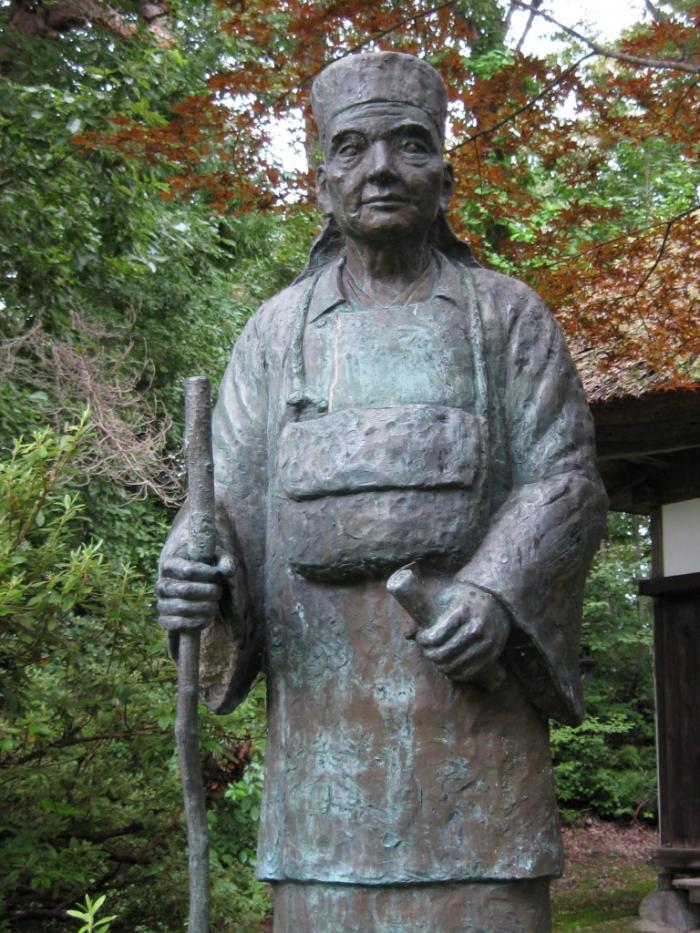
For many people, summer is the season for travel. And for those who practice a contemplative discipline, travel can be a catalyst for spiritual growth. The seventeenth-century poet Basho, master of haiku and author of The Narrow Road to the Deep North, believed that “nothing is worth noting that is not seen with fresh eyes”. His extensive travels freshened and enlarged his vision. Thomas Merton had similar experiences in Asia, as recorded in his Asian Journal.

Yet for those whose primary discipline is Zen meditation, travel can also present a formidable challenge. Insofar as the practice of Zen requires us to sit still, and travel requires us to be on the move, Zen and travel appear to be at odds. How might the one support the other? How might the practice of Zen be integrated with the experience of travel?

To begin with, the practice of meditation can alleviate the anxiety of travel. One of my friends told me the story of being in an international airport on a day when many flights had been canceled. People were berating ticket agents, yelling into their cell phones, and experiencing general misery. Then, as it happened, the Vietnamese Zen master Thich Nhat Hanh arrived in his brown robes, accompanied by the monks and nuns of Plum Village. Silent, gentle, and slow-moving, their presence transformed their environment. People quieted down.

Not everyone, of course, can be so fortunate as to have a troupe of Zen monastics on hand to relieve the fear of travel. But meditative practice, as taught by Thich Nhat Hanh, can calm the fearful mind. As he explains in his book by that title, we can lessen our anxieties not by drugging them with Valium or Johnnie Walker but by honestly acknowledging them and bringing a kind attention to their presence. “Breathing in, I am aware of my anxiety. / Breathing out, I bring kind attention to my anxiety.” Over time, this simple practice can help to diminish the anxiety of travel.

So can the practice of sitting still, even when surrounded by incessant movement. Meditation is often described as a way of “stopping” and “coming home”. By sitting still and following our breathing, we return to the stability of immovable awareness. We restore our equanimity. To be sure, it can be awkward to stop when everyone else is moving or to sit perfectly still in a public place. But we can find ways to sit still without calling attention to ourselves. And more often than not, passers-by are too preoccupied with their own affairs to care whether we are moving or sitting still.

Beyond the maintenance of personal balance, Zen practice can also deepen the experience of travel.  In an earlier column I described the exercise of asking “What is this?” and regarding the things of this world as if we were seeing them for the first time.* When traveling, we really are seeing things for the first time—and quite possibly the last. By asking “What is this?” we become present for whatever we are seeing, be it a glacier in Alaska or a cathedral in Madrid. And the places we see, in turn, become present for us. Later on, we can learn their names and study their histories. But by asking “What is this?” we open ourselves to our immediate experience.

Eihei Dogen, founder of the Soto school of Zen, cautioned against unnecessary travel. “It is futile to travel,” he advised, “to dusty countries, thus forsaking your own seat”. But Dogen was hardly one to talk, being himself a traveler who sojourned in dusty China and brought the practice of Chan back to Japan. And for the resourceful practitioner, travel can become a form of “skillful means,” complementary to sitting meditation and consistent with its purpose.

May your travels be safe and your flights on time.

___________________________________

* Column 34, “What is This?”

Older Posts »